
Download PDF The Great Deformation: The Corruption of Capitalism in America
Just how is making sure that this The Great Deformation: The Corruption Of Capitalism In America will not displayed in your shelfs? This is a soft documents book The Great Deformation: The Corruption Of Capitalism In America, so you can download The Great Deformation: The Corruption Of Capitalism In America by buying to get the soft data. It will alleviate you to review it each time you require. When you really feel lazy to move the printed publication from home to office to some place, this soft data will certainly reduce you not to do that. Considering that you could only save the data in your computer hardware as well as gadget. So, it enables you read it everywhere you have determination to review The Great Deformation: The Corruption Of Capitalism In America
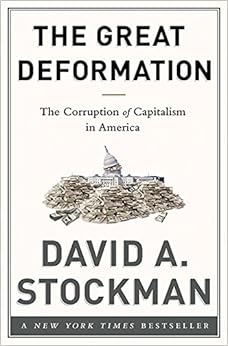
The Great Deformation: The Corruption of Capitalism in America

Download PDF The Great Deformation: The Corruption of Capitalism in America
After often times, publication becomes one of the manners that will certainly urge the system of life run much better. It includes not only the ideas, motivation, point of view, yet likewise the truths. Lots of truths have been disclosed from the books. Numerous literature works are also offered. When you have more time to read, please read this The Great Deformation: The Corruption Of Capitalism In America as one of the analysis products!
Currently, we involve supply you the best brochures of publication to open. The Great Deformation: The Corruption Of Capitalism In America is among the literary work in this globe in ideal to be reviewing product. That's not just this book gives recommendation, however also it will certainly show you the incredible advantages of checking out a book. Creating your countless minds is needed; in addition you are type of people with wonderful interest. So, guide is really suitable for you.
Book comes with the brand-new details and also lesson every time you read it. By reviewing the content of this publication, also couple of, you can get just what makes you feel pleased. Yeah, the presentation of the expertise by reviewing it could be so small, but the influence will certainly be so terrific. You could take it much more times to understand even more about this publication. When you have finished content of The Great Deformation: The Corruption Of Capitalism In America, you can truly understand just how value of a book, whatever guide is
Well, when else will you find this prospect to obtain this publication The Great Deformation: The Corruption Of Capitalism In America soft documents? This is your great chance to be below as well as get this great book The Great Deformation: The Corruption Of Capitalism In America Never leave this publication before downloading this soft documents of The Great Deformation: The Corruption Of Capitalism In America in web link that we provide. The Great Deformation: The Corruption Of Capitalism In America will really make a lot to be your best friend in your lonely. It will be the best companion to boost your business and also leisure activity.
From Booklist
Stockman, veteran of the Reagan White House and Wall Street, offers his self-described polemic, a wide-ranging indictment of the American government-economic complex; free markets and democracy have been under long-term attack, and the author explains why we have myriad problems, perhaps intractable. He indicates the book “contains much original interpretation of financial and public policy events and trends of the last century, even a revisionist framework.†Stockman concludes his lengthy controversial argument with: “the cure . . . is to return to sound money and fiscal rectitude and to correct the great error initiated during the New Deal . . . . In pursuing humanitarian purposes the state cannot and need not attempt to manage the business cycle or goose the free market with stimulants for more growth and jobs; nor can it afford the universal entitlements of social insurance. Its job is to be a trustee for citizens left behind, maintaining a sturdy, fair and efficient safety net.†This thought-provoking book will contribute to important debates on these issues. --Mary Whaley
Read more
Review
Kirkus Reviews “Stockman performs a real service when he debunks the myths that have been associated with Reagan's conservatism and promotes Eisenhower's fiscal and military conservatism…. Stockman forcefully conveys enormous amounts of knowledge.”LewRockwell.com “Stockman produces a persuasive and deeply relevant indictment of a system dangerously akilter…. What Stockman has written is a book that makes clear we are that future generation of the past, inheritors of all the wishful thinking, simple illogic and flawed compromises that produced the near-term benefits our parents and grandparents worried about but ultimately wanted. And now it's payback time.”Steve Weinberg,USA Today “Stockman devotes some of the book to the past five years, joining multiple previous authors who have presented their nominations for the villains and heroes of the 2008 economic collapse. As a book critic and investigative reporter, I have absorbed a dozen of those previous books. Stockman's is my favorite because of his original research, the context he presents (starting with the economic depression of the 1930s), his former insider status, and his apparent political non-partisanship during the endeavor.”David Weigel, Slate “I'd read this book 10 times before I read another possible presidential candidate's memoir of how his Real American Story schooled him in the Audacity of Hope. …a coherent vision of a World Without the Fed.”Paul B. Farrell, Marketwatch “In The Great Deformation, David Stockman – former US congressman and budget director under Ronald Reagan – tells the story of the recent crisis, and takes direct aim at the conventional wisdom that credits government policy and Ben Bernanke with rescuing Americans from another Great Depression. In this he has made a seminal contribution. But he does much more than this. He offers a sweeping, revisionist account of US economic history from the New Deal to the present. He refutes widely held myths about the Reagan years and the demise of the Soviet Union. He covers the growth and expansion of the warfare state. He shows precisely how the Fed enriches the powerful and shelters them from free markets. He demonstrates the flimsiness of the present so-called recovery. Above all, he shows that attempts to blame our economic problems on "capitalism" are preposterous, and reveal a complete lack of understanding of how the economy has been deformed over the past several decades…Thanks to The Great Deformation, not a shred of the regime's propaganda is left standing. This is truly the book we have been waiting for, and we owe David Stockman a great debt.”Booklist “This thought-provoking book will contribute to important debates on these issues.”Washington Post “His rhetoric in a recent New York Times op-ed piece ignites like Seal Team Six coming at you, flash grenades exploding, assault weapons blazing. No wonder he triggers wild angry, hatred and revenge. Yes, he's a truth-teller. And truth hurts, flushing out his enemies. Why? They're sucking trillions from Americans. So you hate him. Counterattack. Big mistake. Don't dismiss David Stockman. He's no Kim Jong-Un blow-hard.”Bruce Krasting “This is a history book. It's a detailed account of the key events since the Depression that have shaped modern finance. I love history, and I'm familiar with those events. Stockman's spin on financial history makes for a very good read. There's something for everyone.”Reuters Breakingviews “For anyone whose economics are Austrian, and who agrees with Stockman that crony capitalism and corruption have led both fiscal and monetary policies into a cycle of ever-increasing stimulus and ziggurats of debt, ‘The Great Deformation' is gloomily persuasive – and bodes ill for the future.”Townhall.com “Agree with Stockman or not, one can't deny that he's a colorful writer!”Rick Santelli, CNBC “Squawk on the Street”
Read more
See all Editorial Reviews
Product details
Hardcover: 768 pages
Publisher: PublicAffairs; 1st edition (April 2, 2013)
Language: English
ISBN-10: 1586489127
ISBN-13: 978-1586489120
Product Dimensions:
6.5 x 2.2 x 9.8 inches
Shipping Weight: 2.4 pounds (View shipping rates and policies)
Average Customer Review:
4.3 out of 5 stars
419 customer reviews
Amazon Best Sellers Rank:
#56,743 in Books (See Top 100 in Books)
For devoted followers of David Stockman's blog, this book is like fundamentalist scripture. Anyone trying to better understand the intensity of the daily diatribes on his Contra Corner website needs to read The Great Deformation to gain full immersion into his torment. He believes that our global economic system has become progressively unhinged over the past three decades and is now poised for a catastrophic collapse unlike any that has gone before. The book is a kind of conservative answer to Karl Marx's theory of capitalism's end-game crisis, except that Stockman sees statist intervention - which has grown in scope over most of the past century - as the problem's cause, not its solution. In his view, Keynesian policymakers are like doctors continuously upping the dosage of bad medicine in a self-defeating effort to cure a disease they themselves have caused.The primary targets for Stockman's wrath are the world's central banks, and in particular the U.S. Fed. He sees The Fed, under Paul Volcker, as having done God's work in the early 1980's in taming the ruinous inflation that followed Richard Nixon's 1971 decision to default on America's gold-for-dollars promise that had for the preceding two decades successfully underwritten the world's monetary system. When Volcker retired, however, the devil took control in the person of his successor Alan Greenspan. Both Greenspan and his own successor, Ben Bernanke, poured liquidity onto every small crisis and drove the short-term policy rate along a secular downtrend that finally guttered out at zero in 2008, where it has remained. Stockman sees this chronically loose monetary policy as doing little to help the "Main Street" economy, but everything to help Wall Street, which he believes has turned the Fed into its lap dog. Virtually free money, procured in the repo and other short-term markets, is used to fund aggressive leveraged speculation that drives the prices of stocks and other financial assets to unsustainable levels that inevitably collapse in crashes such as occurred in 2008. Connected fast-money players are able to read the signals and dump or reverse their positions in time to escape the full weight of the carnage, which is born mostly by hapless Main Street investors trapped in slow-moving mutual funds. The Fed then starts the process all over again by re-inflating the markets with fresh liquidity infusions.Stockman is a free-market conservative, but many of his rants would sound at home on the pages of Mother Jones, Daily Kos, or any of the other leftwing soapboxes where the same nails are hammered. Like his leftist counterparts, Stockman rails about the growing concentration of wealth in America which, in contrast, he blames not on "capitalism" but on the cozy relationship that's developed between Wall Street and the government's monopoly bank, i.e. the Fed. Exclusive hedge funds and private equity firms are the vehicles through which the rich are able to compound their wealth. These are, of course, the very players who have learned how to exploit the Fed's interest rate suppression to pursue leveraged buy-outs, debt-financed share repurchases and other forms of financial engineering that provide high returns for their wealthy principals while increasing systemic risk for everybody else. Stockman believes that these destructive practices would be minimized in an environment where free markets were allowed to punish them with high interest rates.There is an air of wounded innocence about David Stockman, who in his youth once attended Harvard Divinity School. He has a sincere and honest belief in the efficacy of free markets, which he sees being trampled everywhere he looks. He first rose to prominence in the early 1980's as Budget Director for the Reagan White House, where he arrived with a sharp mind and bright eyes, hoping to serve the cause of honest budgeting among ideological soulmates. What he found instead was an administration that had been hijacked by budget busters on all sides: monomaniacal "supply side" tax-cutters and "neocon" advocates for unconstrained military spending. It was, paradoxically, the Reagan administration that gave rise to the belief that "deficits don't matter", a notion that has metathesized into a lethal mantra now three decades later in the era of Barak Obama. Stockman believes that the combination of costly imperial overreach and the Ponzi-scheme financial logic inherent in the structure of social entitlement programs has now taken America to a point of no return. The colossal rickety machine continues to lumber along only because the Fed manages the funding cost through interest rate suppression. And that lasts only so long as foreigners go on buying the bonds needed to fund the deficits. These days are now numbered. And because America had led the world since World War II, its other major economies, including China's, have fallen in line behind us as we all descend into the same treacherous dysfunction. The crack-up, when it comes, will be global.Following his rancorous split with Reagan, Stockman found his way to Wall Street, of all places, like an honest priest stumbling into a brothel. He then wound up at a private equity firm, no doubt initially believing in that industry's self-defining mission of strengthening free enterprise by ridding companies of waste. What he found himself doing instead was taking control of vulnerable businesses, stripping them of resources, loading them up with unsustainable debt burdens, and plotting profitable exit strategies for himself and his partners. At one point he was even personally indicted for fraud, and while the charges were eventually deemed groundless and dropped, the former divinity student has to have begun questioning the road he had taken in life.Traumatized by experience, he moved on to become a full time financial writer' He now declaims to us like Cassandra wailing from the top of the temple stairs in doomed Troy. In the bitterly partisan climate of contemporary America, Stockman is refreshingly non-partisan as he slams with equal virulence politicians of both major parties. He despises Richard Nixon for destroying sound money with his 1971 decision. He holds George W. Bush in even lower regard for accelerating the fiscal doomsday clock by embracing big government, costly military entanglements and lower taxes for rich people all at the same time. Democrats Jimmy Carter and Bill Clinton actually get off with a lighter touch, since Stockman credits them with at least a modicum of respect for fiscal prudence. Barak Obama, however, is another story altogether, as he has doubled down with the hated Keynesian poison since the day he came into office.There are, in my judgment, stylistic problems with Stockman's writing. He's shrill and grossly repetitive, and he probably could have covered the ground nicely in this book in half of its 712 pages. He writes in the rolling cadences of an angry prophet, and he at times allows passion to outrun his logic. This book is full of facts and figures, but apparently not wanting footnotes to slow him down, Stockman provides not a single one.Still, I've learned to trust him, and I find most of his case compelling, despite his exaggerations, his unwillingness to see much good or wisdom in anyone, or his inability to offer practical solutions to the problem he describes. His last chapter is entitled "Sundown In America", which strikes me as far too peaceful a metaphor for the explosive picture he paints in this book.
David Stockman believes that our economy is almost past the point of no return. With a staggering federal debt and a deficit that keeps rising, he considers our economy to be a "setting sun" economy- our best days are behind us. But there's still hope, it's not too late to turn it around.The book starts off with details on how, in the past, the banks leveraged capital and how their methods of investment were contingent on a constant upward spiral of success. He goes on to talk about how the fed propped Wall Street up with hopes of creating wealth through the stock market and that he believes they have overstepped their bounds. He criticizes Greenspan for his fiscal policies and compares that bubble to the one we are in today. Most of the book talks about the past and how we can relate it to the present and what we can learn from the mistakes made by our predecessors.The facts and statistics he presents show that the "too big to fail" ideology adopted by the government was incorrect and in fact, many of the companies that received bailouts had sufficient assets to fend for themselves. Using AIG as an example, he outlines the overall sector's strengths and weakness during the crash of 2008. He asserts that during times of financial crisis, such as the crash of 2000, companies would inaccurately portray sales in order to make their company appear more valuable.Highly critical of the Fed, many of his opinions are based around failures of the federal government to correctly manage the economy. Most of the time, he believes that their attempts to bolster the economy stem from pressure from business, rich people, or other government entities. He takes the reader through all of the United States' bubbles since before the Great Depression and explains the causes of each one. According to his statistics, most of the bubbles were caused by the Fed unnecessarily pumping money into the economy. He talks about the $800 billion stimulus and the minimal impact that it has had. He believes Bernanke and Obama are merely buying borrowed time with borrowed money.The most interesting parts are when he quotes grim situations which highlight the depth of corruption in the government and big banks. In one instance, during the financial crisis of 2008, the Chairperson of the FDIC was "rarely consulted" and when she was, she was commanded: "you have to do this or the system will go down." There was "no analysis, no meaningful discussion." She expressed her frustration and explained that it became commonplace for her to be forced to carry out orders without being told the reasons or the end goals behind those orders. Generally, the government was unable to give reasons because they were acting on the whim of large banks. In another story, a head government official recounts the CEO of Goldman Sachs coercing him into providing the banks with bailout, lest their be dire consequences. The book has many shocking stories such as these. Each uncovers a different piece of corruption that, when added up, reveals a frightening picture of our government today.Pros:It was VERY detailed. There were countless facts and statistics to support his arguments and viewpoints.It provided a good snapshot into the inner workings of politics and government monetary policy.He provided factual stories and quotes throughout the book.He focused on many of the large power-players in our economy and their roles in the financial crashes.Cons:The book tended to jump from time period to time period. One moment it's about the Great Depression, and the next, it's current. It can make it difficult to follow at times. It also makes it difficult to review.It can be repetitive. Many of the things are said more than once or they are just reworded.It's a bit dry. Even with the stories and shocking data, I still found it hard to concentrate.
The Great Deformation: The Corruption of Capitalism in America PDF
The Great Deformation: The Corruption of Capitalism in America EPub
The Great Deformation: The Corruption of Capitalism in America Doc
The Great Deformation: The Corruption of Capitalism in America iBooks
The Great Deformation: The Corruption of Capitalism in America rtf
The Great Deformation: The Corruption of Capitalism in America Mobipocket
The Great Deformation: The Corruption of Capitalism in America Kindle


0 komentar:
Posting Komentar